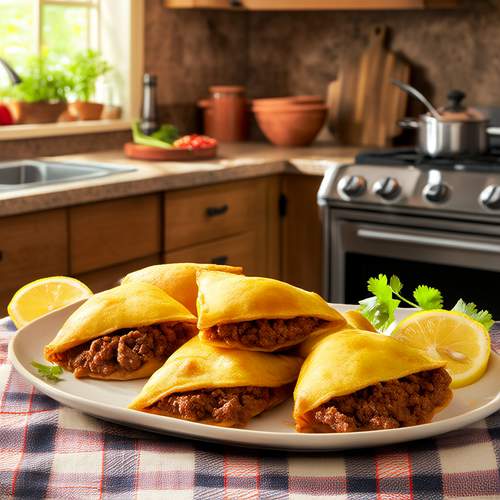
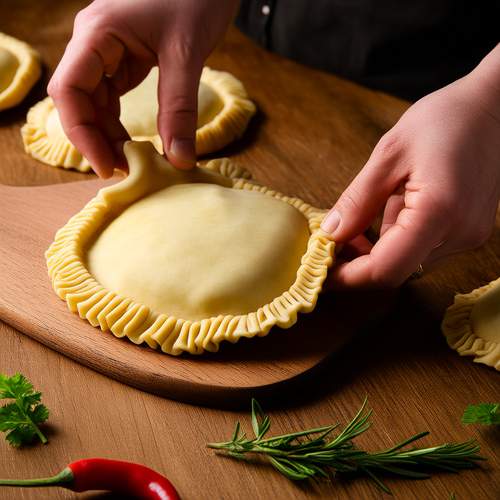
The art of crafting the perfect Argentine empanada extends far beyond the filling. While most discussions focus on the savory contents - whether it be spiced ground beef, gooey cheese, or sweet corn - the true mark of a master lies in the delicate folds that seal these handheld treasures. The repulgue, as Argentines call the crimped edge, serves as both functional closure and edible signature, telling stories of regional pride and personal touch through its intricate patterns.
Walk into any neighborhood empanadería across Argentina and you'll immediately notice the diversity in these edible seams. Some appear like braided ropes hugging the semicircle's curve, others resemble precise fork marks creating uniform ridges, while certain varieties showcase elaborate pinched designs that could rival lacework. These aren't mere aesthetic choices - each crimping style carries geographical and historical significance passed down through generations of home cooks and professional cocineros alike.
The Northern Twist dominates in provinces like Salta and Jujuy, where indigenous influences blend with Spanish techniques. Here, bakers use their dominant hand's thumb to create a series of diagonal folds while rotating the empanada, resulting in a spiral pattern that resembles Andean textile designs. This method serves practical purposes too - the multiple layers of dough at the edge withstand the high-altitude baking conditions where thinner seals might burst. Locals claim you can identify a proper Salteña empanada blindfolded just by tracing the distinctive raised ridges of its repulgue.
Travel southeast to Buenos Aires and the crimping transforms dramatically. Porteño-style empanadas favor the fork-pressed edge, a technique born from the capital's fast-paced culinary culture. Using the tines of a fork to seal the dough creates immediate visual appeal while saving precious minutes compared to hand-crimping - crucial for bakeries producing thousands daily. This method also produces a flatter edge that crisps beautifully during frying, adding textural contrast to the softer filling. Some historians suggest the fork technique gained popularity during 19th-century immigration waves when Italian and French pastry methods influenced local traditions.
In the western wine region of Mendoza, a hybrid style emerges. The Vineyard Crimp combines elements of both northern and porteño techniques - hand-folded but with simpler, wider spaced pleats that resemble grapevines. This reflects the area's viticultural identity while addressing practical needs: the looser seal allows steam to escape during baking, preventing juicy fillings (often containing local Malbec reductions) from making the dough soggy. Many Mendocino families pass down specific repulgue patterns like heirlooms, with subtle variations indicating which relative prepared the batch.
The cultural importance of these edges becomes especially apparent during festivals. In the annual National Empanada Festival in Famaillá, Tucumán, the repulgue competition draws as much attention as the fillings themselves. Judges examine hundreds of entries under strict lighting, evaluating not just aesthetics but structural integrity - a poorly crimped empanada that leaks during baking faces immediate disqualification. Winners often employ extraordinary techniques, like the legendary "52-pleat repulgue" that holds the regional record for most folds on a single empanada.
Modern chefs are now reinventing these traditional methods. At Buenos Aires' trendsetting Empanadas Club, chef Sofia Luna developed a "deconstructed repulgue" where the crimped edge extends dramatically beyond the filling pocket, creating a crispy handle for eating. Meanwhile, in Patagonian fusion restaurants, some empanadas feature asymmetrical seals inspired by indigenous Mapuche pottery designs. Yet even with these innovations, most Argentines agree - the soul of a proper empanada lives in that handmade edge, where dough meets dough with intention and history.
What appears as simple pastry folding actually represents a complex culinary language. The direction of folds can indicate filling types (clockwise for picante, counterclockwise for dulce in some regions). The number of pleats might signify special occasions - quinceañera empanadas often bear 15 distinct folds. Even the pressure applied during crimping matters; experienced cooks develop muscle memory to apply just enough force to seal without compressing the filling.
This edible craftsmanship faces challenges in the industrial age. Frozen empanada producers struggle to replicate authentic hand-crimped edges mechanically, often resorting to generic pressed patterns that lack regional character. Some boutique manufacturers employ teams of abuelas to hand-crimp premium product lines, recognizing that consumers will pay triple for properly repulgued frozen empanadas. Food scientists continue developing machines that can mimic human crimping techniques, though most Argentines can instantly spot the difference.
The next time you encounter an Argentine empanada, pause before biting in. Examine that crimped edge - it likely took someone years to perfect that particular motion. That repulgue contains multitudes: geography, history, personal identity and culinary wisdom all baked into a flaky ridge of dough. In a nation where people debate empanada techniques as passionately as football strategies, the humble crimp stands as both divider and unifier - separating fillings from the outside world while connecting Argentines to their delicious heritage.
By /May 26, 2025
By /May 26, 2025
By /May 26, 2025
By /May 26, 2025
By /May 26, 2025
By /May 26, 2025
By /May 26, 2025
By /May 26, 2025
By /May 26, 2025
By /May 26, 2025
By /May 26, 2025
By /May 26, 2025
By /May 26, 2025
By /May 26, 2025
By /May 26, 2025
By /May 26, 2025
By /May 26, 2025
By /May 26, 2025
By /May 26, 2025
By /May 26, 2025